

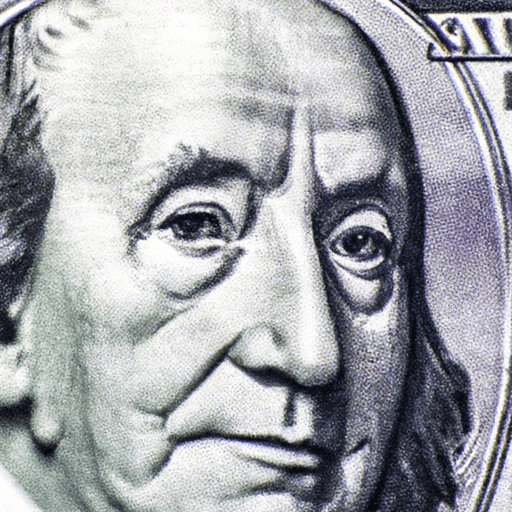
The United States $100 bill is the highest denomination of paper money currently in circulation. It is widely used in both domestic and international transactions and is a symbol of wealth and power around the world. But who is on the $100 bill?
Who is on the $100 Bill?
The $100 bill features a portrait of Benjamin Franklin, one of the Founding Fathers of the United States. Franklin was a polymath who made significant contributions to science, politics, literature, and more. He was also the first Postmaster General of the United States and was instrumental in the creation of the nation’s first library.
History of the $100 Bill Design
The design of the $100 bill has changed over the years. The first $100 bill was issued in 1862 and featured a portrait of Salmon P. Chase, the Secretary of the Treasury at the time. In 1914, the portrait of Benjamin Franklin was added to the bill along with a vignette of Independence Hall. The design of the bill was updated in 1996 to include a series of intricate security features, such as a watermark, security thread, and color-shifting ink, in order to combat counterfeiting.
The $100 bill is an iconic symbol of American currency. It is widely used in both domestic and international transactions and is a symbol of wealth and power around the world. The portrait of Benjamin Franklin has graced the front of the bill for over a century, a reminder of the contributions of one of the Founding Fathers of the United States.
The $100 US Dollar Bill is the highest denomination of currency in circulation and features the portrait of Franklin D. Roosevelt, the 32nd President of the United States. The first $100 Bills were issued in 1862 and the bill has changed several times over the years, but Roosevelt has remained the face of the $100 Bill ever since his portrait was added in 1914.
Roosevelt’s tenure as President spanned from 1933 to 1945 and during this time, he was active in leading the United States through the Great Depression and World War II. He was a firm believer in the concept of a “New Deal” for the American people, and worked to regulate the banking industry, expand public works projects, and stimulate economic growth. He was also a staunch advocate for civil rights, joining with Congress to pass the Civil Rights Act of 1964.
The back of the $100 Bill features a scene inspired by the 18th-century painting “The Apotheosis of Washington”, by Italian-American artist Constantino Brumidi which was created to adorn the rotunda of the Capitol in the US Washinton, DC. The painting depicts George Washington surrounded by figures personifying Liberty, Fame and Victory. This scene is a visual testament to the courage and vision of the nation’s first leader, George Washington, and immortalizes his contribution to the establishment of the United States of America.
Though the faces and images on the $100 Bill have changed many times in the past 158 years, FDR will remain the face of the $100 Bill for decades to come.